How to have a better death, Rums (just because), some grief lasts a lifetime, and how to learn from great loss.
Read moreThis is Interesting #2
M.C. Escher
Your Custom Text Here

M.C. Escher
How to have a better death, Rums (just because), some grief lasts a lifetime, and how to learn from great loss.
Read more
What I found interesting this week. East vs. West concept of last words, what makes life meaningful at the end-of-life, and judging others grief.
Read more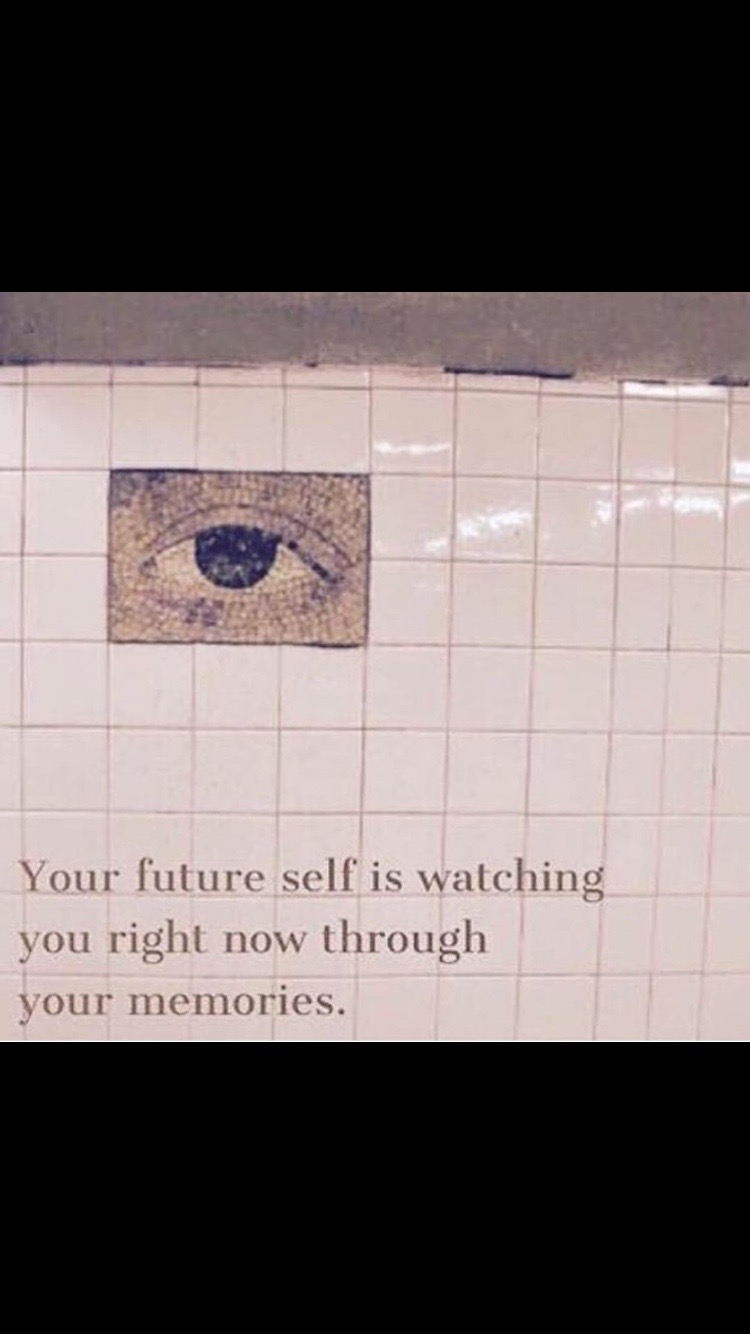
I can see myself reflected in the grief of my loss and that reflection is not static. It is dynamic and moves forward the in ripples and eddies of a stream even as I stand in place.
Read more
I guess my first goal is to find the peace in the solitude of writing, the book, blog posts, and not jump up to do something else. To learn to sit and listen quietly to my inner voice. To not look at what’s next or what do I do to fill the time with chores and acts.
Read more
The iPod Original was a 2001 Christmas gift from Donna
Grief is a playlist playing in the background. It is the sound track of your life after the loss of a loved one. Some turn it off and find a new list. Others listen to their and dance to it or sing or cry or let it just play. It is your playlist and your choice.
Read more
My Sims avatar of Donna
When we grieve we live in a world created by death and memories. That world does not have to be stagnant it can be dynamic and healing. Grief mimics the worlds Sims players create and thrive in. We can thrive in our Sims like world of grief and memories.
Read more
During her time in hospice she was on the knife edge of death yet there were some very Donna moments. She did not loose herself to death she remained true to her being. At the end she gave me the gift of being Donna.
Read more
Donna at the cottage in Cape Elizabeth, Maine
Those memories (skills) Donna had died with her. Though they were effectively removed from my heart they were not lost as much as witnesses to deficits in my life now. Twice a year when I am faced with changing the shames and duvet I remember what I didn’t remember, Donna did this.
Read more
It seems when I come to a point in my grief journey that I feel I have a fixed end point or place of repose I find a new fork in the road. A new path to examine and come to another understanding no matter how brief or tenuous. Grief, in a fashion, is organic learning.
Read more
Helpful, timely social support is the single strongest determinants for those grieving to arrive at positive psychosocial outcomes. The ability to modify many if any of the factors impacting our individual grieving journey cannot be modified after the fact to the extent that social support can.
Read more
It's not as if grief speaks to me per se. It is more that in this state of grief whether roiling or calm grief heightens my awareness. I hear a phrase, read a passage, listen to a song and think about it. Just think and learn. Learning is the only thing that changes our consciousness. Even within this state of grief driven knowledge I wonder, am I missing today and tomorrow because my vision is in my rear view mirror? Can I untangle myself from looking back to construct a new environment for my emotions to reside?
Read more
I am not sure I ever really tried to achieve closure or even considered it. Closure is a myth. Closure is indifference. Closure is denial said pretty.
Read more
Hospice is about dying well. There is no good death. Any death is bad and painful but dying well surrounded by friends family loved ones changes the dynamic for both the patient and the family. It makes the time to the finite end better and kinder and comfortable but more important is the time after death. That is our long darkness, the time after death of a loved one.
Read more
Identifying my journey as starting at caregiving seems odd since there is a whole shit load of years prior to that 2009 moment when you learn your wife of 28+ years has advanced cancer and six months to live. I guess that is where life for me began, with the specter of death looming over us both. Life begins at death? How odd
Read more
From July till August the waves of memories rage and roil within me so much so that I go back and bring forward what was to what is. I wish I could follow one of Donna’s mantra’s “There’s a reason they call it history. It happened then.” During Dying Season then is now.
Read more
At 8:45 plane engines overhead rattled the building so severely I instinctively ducked my head into my keyboard. Seconds later there was what could only be described as an explosion.
Read more
“Now would be a good time to have end-of-life discussions with her,” the Hospice Rabbi and social worker said. “What does she want for her funeral? What are her regrets? Did she find joy in her life?”
Read moreDonna and Nina taking a nap before Sunday Dinner
Loss, grief, and mourning is the furniture I've placed in the rooms of my life. I rest on them, sleep on them, put my feet up to watch TV, and game. I move my grief furniture around to see what works better where. What I don’t do is put them in storage nor leave them for Goodwill. These are the emotional elements of my life.
Read more
Monday July 11 Dr. B had scheduled an MRI and other tests. I mostly sat and texted friends to let them know where Donna was and why. I was trying to escape where I was with thoughts of chores: heading home to free Nina from doggie daycare, feed her, and give her insulin before returning to the hospital. Donna returned to her room after the MRI. Donna rested in her hospital bed looking so small. She was a figure on the horizon moving away from my sight.

We sat and talked. We didn’t speak about the future which felt like a dense fog settling around our shoulders. Our hopes reflected off the mist. Of course there was a future. There always is a future but not one you could see it or want to. There was only the immediate moment to navigate to get to the unseen future. The future never stops and waits for us. It just hides while you struggle to visualize what it may be. I left that evening and entered an empty home.
The next day Donna was to have a thoracentesis to drain the fluid around her lungs.
I held Donna’s hands and watched her grimace as the resident pushed the catheter through her back, into her lung cavity. “This will work,” I thought. “This will work, she’ll be home soon.”
The next day there was good news. The thoracentesis had worked.
Until it didn’t. The fluid came back. I held her hand again, watched her face again, as another catheter stabbed her back. This time it worked. Until it didn’t.
“We need to discuss palliative care,” Dr. B. said.
“Great,” I thought, “this will give us, her, me, more time.”
Normally there were two chairs in the room. Today it looked like a makeshift conference room with four additional chairs. They were perfectly arranged to project a sense of community and comfort. Dr. B. orchestrated where the chairs were placed, who sat, and who stood, thinking all the while of how this meeting would affect her. Palliative care was going to be a major change in her status. No longer was Donna living and being. She was Donna at the end of life.
The residents, social workers, and Hospice staff attending the meeting followed Dr. B.’s lead, staying focused on Donna the person, her life, and my status. Nobody was making the rounds with a clipboard.
Donna wasn’t engaged. Her eyes followed the chairs being moved and the white coats assembling. Her shoulders slumped in surrender. It was the first time I’d ever seen her passive. She wasn’t asking questions. “Don’t give up,” I thought. “Don’t, please.” I couldn’t say it out loud because it would expose the obvious, that she was unable to rise and take flight from her bed.
Dr. B. and Dr. S. suggested Home Hospice. When the Hospice intake staff spoke with me, they weren’t wearing white coats. This was not clinical. It was business. The conversation felt like a sales call, done in a busy hallway of rushing physicians and nurses, with families of patients sitting nearby. Here I was, speaking and answering questions about Donna’s death, in the most public of venues for the world to hear. Intake handed me papers to sign. I did not feel like a person about to lose his wife of 28 years, being offered hope and dignity. I felt like a transaction. The home hospice staff scheduled a delivery of the bed and other items. The next day I sat home and waited. I bought sunflowers to brighten up what would be her death bed.

That Saturday Dr. S was reviewing charts on the unit. We spoke and he said the staff, Dr. B, and hospice thought the in patient hospice unit would be a better alternative for Donna and me.
I had been holding on to that trope of a wonderful, peaceful death at home, surrounded by friends and family circling her bed like supplicants kneeling to receive the communion of her life passing. Now I was hearing that even if she came home, she wouldn’t have that. I wonder to this day if Dr. S. was straight with me, or if they all thought I was a caregiving failure and couldn’t be trusted.
On July 18, 2011 Donna was transferred to the hospice unit.

Donna and I returned from Maine July 2, 2011. Our time at the cottage Donna tired easily and found walking, especially the stairs from the deck down to the driveway very difficult. I held her arm as she navigated the stairs one painful step at a time. This trip to Maine was precious. We walked to the beach with Nina, cooked lobster, went for ice cream, and shopped in Portland. As I look at the photos from that trip she seems resigned to her reality.
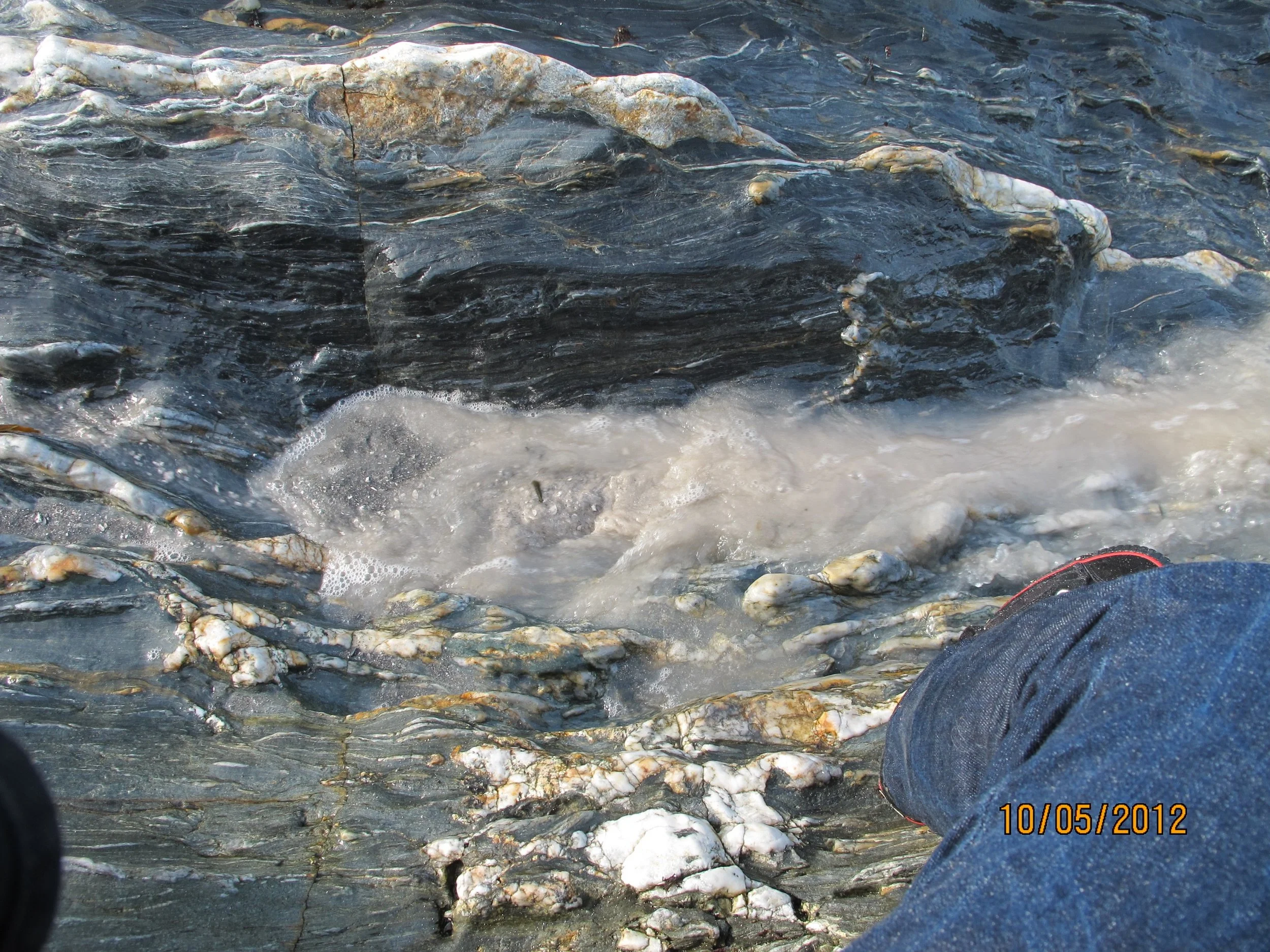
A year later, October of 2012, I went back to the cottage with Nina to spread some ashes in the cove where we once sat and stared at an infinite horizon of the ocean. When Nina and I arrived at the cottage I sat in the car unsure of why I went back. I was afraid of the memories. I felt lost and alone. Being here without Donna was a slap in her face coming to the place she loved without her. Yet here I was after six hours of driving. I took the bags to the bedroom. When I closed the door, there behind the door on a hook, as if waiting for our return, was a scarf Donna had forgotten. It was going to be okay she was there with us.
July 4, 2011 was quiet and I made hamburgers. Donna’s oncologist scheduled a CT for July 7 to determine if the new round of chemo, Gemzar, was working. His hope was that if we could shrink the tumors this might resolve the pain. Donna’s first and second rounds of chemo in 2009 and 2010 worked why wouldn’t this one. Why? The pain from the hypertrophic pulmonary osteoarthropthy was not resolving and NSAIDs were the drug of choice. NSAIDs gave her some relief. Just some.
On July 7 we went to the CT center. I helped her put on a gown and lifted her onto the CT table for her scan. It was freezing and Donna’s teeth were chattering. We covered her and I walked to the waiting room fearing of what would be seen. At home we had dinner and watched TV. It was an early night since the next day Donna was scheduled for her next round of Gemzar.
At the oncology center we checked in at the desk and sat to be called for chemo. I stood to go get some soup for Donna which she liked while getting an infusion. As I was about to leave looking at Donna to make sure she was okay. Dr. B came out and asked us both to an exam room. As always he held the door and asked about us. We walked the hallway with exam rooms on either side. We entered exam room 5 and sat. I remember feeling I was living in the burnt edges of hope.
Dr. B a generous oncologist with heart, spirit, compassion, and brains said the CT showed that the Gemzar was not working. The tumors had grown a bit. He was not sure what the next line of treatment would be if any. More troubling was the finding of fluid in the pleural cavity, the membrane surrounding the lungs. It needed to be drained.
Dr. B scheduled a thorcentnesis for Monday July 11. Donna would be admitted to the hospital for two days and sent home.
Needless to say we spend the weekend in a fairly low key fashion. That is being generous, it was more zombie like. On a usual weekend the events were menu selection for Sunday, shopping, either eating in or out on Saturday. Then a movie. Sunday was cooking. I didn’t have the energy or drive to shop or cook. Besides Donna was going to be in the hospital. Sunday we walked to a local restaurant three short blocks away, the Odeon.
The Odeon has been a staple in the neighborhood since 1980 when it was a great dinner spot (still is) in Tribeca, best brunch for a hungover Sunday, and a late night post disco SNL crowd. We knew of it and visited before we moved here. The food was French bistro.
We left our apartment and slowly walked to the Odeon. The pain was evident on Donna’s face and breaths as she navigated haltingly stepping up the curb even with a wheelchair ramps. We sat and had dinner mostly in silence. Generally we can spend time together just being us without talking. This evening the silence was not wanting to speak about tomorrow for fear the devil would take notice. The walk back was a slow and telling. It said so much than any scan, lab report, or medical file. It felt like a final chapter of a novel. We finally and painfully made it home. I helped her change into PJ’s. We watched some TV but turned in early.
The next morning July 11, 2011 we woke as usual. I made Donna a latte. I had espresso. I took Nina to doggie daycare. When I returned I helped her dress and we headed out. The exercise of closing and locking the door done a million times felt different. I did not completely understanding that moment in our lives. Mostly in her life.
“Closing The Door
One day arm and arm
We left home and closed the door
You never returned”
I carried her to the corner and got a cab. We arrived at the emergency entrance of the hospital. I ran in got Donna a wheelchair and pushed her into to admitting. We were told to head to the 9th floor. Donna needed to use the bathroom. I carried her in helped her sit and carried her back to the wheelchair. This was a first for us and I am sure she was mortified. We made it to the 9th floor her room was waiting or was it laying in wait.